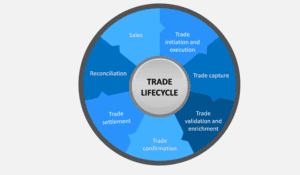
The trade life cycle in the Over-the-Counter (OTC) market refers to the various stages involved in the processing and settlement of trades that occur directly between parties, outside of organized exchanges. Here are the key steps in the OTC trade life cycle:
1: Trade Initiation: The trade life cycle begins with the initiation of a trade. Parties involved, such as institutional investors, hedge funds, or banks, negotiate the terms of the trade, including the quantity, price, and settlement date. This negotiation is typically facilitated through electronic trading platforms or over-the-phone communication.
2: Trade Execution: Once the trade is validated, it moves to the execution phase, where the actual settlement and movement of funds or securities take place. The execution process may involve several intermediaries, such as custodians, brokers, or central counterparties, depending on the specific trade and market requirements.
3: Trade Capture: Once the trade terms are agreed upon, the details are captured and documented by both parties involved in the trade. This includes recording the trade information, such as the security, quantity, price, and counterparties involved. Trade capture may occur through electronic trade confirmation platforms or through manual entry into trade processing systems.
4: Trade enrichment: Adding economic details to the trade. Economic details- commission charges,taxes etc non-economic details – bank account and custodian account .
5: Trade Validation: Following the trade confirmation, the counterparties or their respective middle offices perform trade validation to ensure that the trade conforms to various compliance checks, risk limits, and internal policies. This step involves verifying counterparty information, regulatory requirements, trade eligibility, and other checks necessary for risk management
6: Trade verification: Here trade is compared with the trade sheet (email/Excel file sent from front office of middle office) just to make shure that details are entered and booked are correct.
7: Trade Confirmation: After capturing the trade details, both counterparties exchange trade confirmations to validate and confirm the agreed-upon terms. Trade confirmations typically include essential information, such as the trade ID, settlement date, pricing, and any additional conditions. It is crucial to ensure the accuracy of trade confirmations to avoid discrepancies.
8: Trade Settlement: Once the trade confirmations are matched, the settlement process begins. Settlement involves the transfer of funds, securities, or other financial instruments between the counterparties, according to the agreed-upon terms. Settlement may occur through various methods, such as book-entry transfers, delivery versus payment (DVP), or payment versus payment (PVP), depending on the market and asset type.
9: Trade Reconciliation: After the settlement, trade reconciliation takes place to verify that the actual settlement matches the expected outcome. This step involves comparing trade data, financial records, and positions to identify and resolve any discrepancies or errors that may have occurred during the trade life cycle.
10: Trade Reporting: Finally, trade reporting is conducted to fulfill regulatory requirements and provide transparency in the market. Both counterparties are responsible for reporting trade details to the relevant regulatory authorities or trade repositories, as mandated by the applicable regulations.
It’s important to note that the trade life cycle may vary depending on the market, asset class, and specific regulatory requirements governing OTC trading in different jurisdictions.
Exchange Trade Life Cycle
The exchange trade life cycle refers to the series of steps involved in the process of executing and settling a trade on an exchange. Here’s an example exchange trade life cycle:
1: Order Placement: The trade cycle begins when an investor or trader places an order to buy or sell a financial instrument, such as stocks, bonds, or derivatives, through a trading platform connected to the exchange.
2: Order Routing: Once the order is placed, it is routed to the exchange where the financial instrument is listed. The order routing process involves transmitting the order electronically to the appropriate exchange.
3: Order Matching: At the exchange, the order is matched with a corresponding counterparty. If a buy order matches with a sell order, and both parties agree on the price, quantity, and other relevant details, the trade is executed.
4: Trade Execution: Once the order is matched, the trade is considered executed. The exchange generates a trade confirmation that includes information such as the trade price, quantity, trade date, and time. This confirmation is sent to both parties involved in the trade.
5: Trade Reporting: The exchange reports the executed trade to relevant market participants, regulatory bodies, and market data providers. This helps maintain transparency and facilitates price discovery in the market.
6: Trade Clearing: After the trade is executed, it goes through the clearing process. Clearing involves verifying the trade details, reconciling the positions of the buyer and seller, and calculating the obligations for settlement.
7: Trade Settlement: In this stage, the buyer delivers the funds and the seller delivers the securities to complete the transaction. Settlement may involve the transfer of funds, securities, or both, depending on the financial instrument being traded. Settlement can occur on the same day (known as T+0) or may take a few days (T+1, T+2, etc.) depending on the market and the instrument.
8: Trade Confirmation: Once the trade settlement is completed, the exchange sends a trade confirmation to both parties involved in the trade. The confirmation provides details of the settlement, including the settlement date, amount settled, and any relevant fees or charges.
9: Post-Trade Processing: After settlement, various post-trade activities take place, including reconciliation of trades, margin calculations, risk management, and updating of account balances and positions.
It’s important to note that the trade life cycle can vary depending on the specific exchange, financial instrument, and market regulations. The example above provides a general overview of the exchange trade life cycle, but the specific details and steps may differ in practice.
 Site Title